SCOTLAND
The Seasons of Exploration
Preparing for another few seasons of exploring the great outdoors. From camping in the Scottish Highlands, picking fruit in the sun and day trips to historic sites.
The Equinox of Adventure
I have always been a fan of winter. However, it does not hold anywhere near as much fondness in me as the spring and summer.
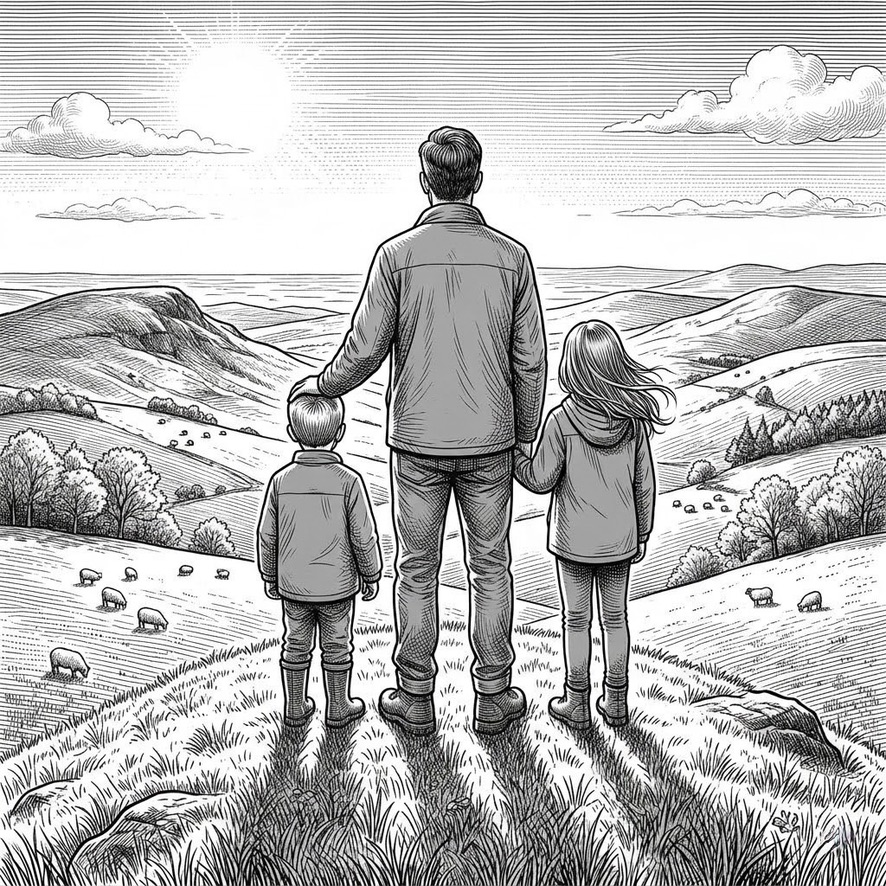
I am currently beginning to plan some adventures for myself and my children. In previous years I have taken them to the Highlands of Scotland to view a variety of things — desolate castles, palaces that are still occupied, landmarks in neighbouring cities.
A Quiet Shift
When I was younger, cities were everything — the culture, the evening energy, the sense that something was always happening just around the corner. Food, events, people moving with purpose. I loved it.
Nowadays, I find myself drawn somewhere quieter. The open expanse of rolling hills. The wide reaches of the sea. An endless sky with nothing underneath it asking anything of you.
Places like Ullapool — a small, unhurried port town on the west coast — hold more for me now than any city centre could. I was last there boarding a ship to the Outer Hebrides, and I remember standing at the water’s edge thinking that this was exactly enough. Aviemore, Inverness, anything that sits inside the Highlands — there is a magic to that region that I do not think I will ever fully put into words, and I have stopped trying. I just take the children and let them feel it for themselves.
The Outer Hebrides
In January 2024, I visited the Outer Hebrides, sometimes known as the ‘Western Isles’ or ‘Long Isle’, with a friend of mine. I am not really sure why the decision to go there was made, but I am glad it was made.
The Isle itself was very much like the Highlands.
Stornoway was the biggest town there and it was lively but lacking the same liveliness that you would find in a mainland town. I did feel like a tourist there though. If you spoke English there, you were a tourist.
I have heard that the Isle is considered the final bastion of Scots Gaelic. Signage there is in both languages but Gaelic is the language of the Isle, I felt.
There was plenty to see but the biggest sights for me were the unspoiled beaches. They would be tourist spots for sunbathing if it only was 15-20 degrees hotter and not as windy!
Otherwise, the Hebrides felt very much like the Highlands except you knew that you were almost off-grid from humanity.
We stayed in a place called Eoropaidh, near the tip of the Isle. Close to midnight, the dog needed a walk — and stepping outside, I felt genuinely unsettled by the dark.
Normally when you go out at night you have the comforting assurance of street lighting or neighbours casting some sliver of lighting to the point that it illuminates the surrounds slightly.
In this place, there were a handful of neighbours but they turned their lights off, there were no wasteful ‘always-on’ lights on their houses and there were no street lights.
I left the Airbnb we were staying in and once I left the confines of this nook, I could barely see 2 metres in front of me!
The wind was blowing and I could not see anything; this chilled me for a while because I would be none the wiser if someone snuck up on me.
As I was standing in this open field waiting for the dog to have her final sniff of the evening before bed, there was one light that periodically shone on the horizon and that was the ‘Butt of Lewis Lighthouse’ (why Lewis’ Butt had a lighthouse was beyond me. Sorry - bad joke. Anyways…)
I rushed back to my friend and informed him that we should take this opportunity to go and see if we could see the stars. So, we went out the following night when there was a clearer sky (it was still somewhat cloudy but not as much as the previous night) and we saw the stars - a lot of them. It was a long line of stars that were littered in the sky and we saw what I can only describe as the Milky Way — a long stripe of stars across the sky I’d never seen with my own eyes before. I tried to take a picture but it was so dark that the ISO was so high, the image was unusable.
I would like to return with my kids to have them experience that same star dust and witness for a moment the void of humanity in such a remote place. It is surprisingly calming and restorative, especially if you are like me and deal with humans on a daily basis.
The Night We Slept Under the Stars
Of all the trips we have taken, one stands apart.
It was a Saturday. My wife was abroad. Somewhere in the middle of that morning, I made a decision — the kind that does not survive too much thinking — and sent her a message that simply said we were going camping. Why not. Life is too short.
We packed the tent, the sleeping bags, the cooking equipment, the provisions, and by lunchtime we were on the road to Glenmore, east of Aviemore, on the edge of the Cairngorms. We put the tent up, spent the day doing what you do in a place like that, and felt very pleased with ourselves.
Then the evening came, and so did the wind and rain.
The tent held, but sleep did not. At some point I made the call — we folded the back seats down, laid out the air mattress across the boot, and the three of us climbed in. It was not glamorous. It was very much fine.
What happened later was not fine. It was something else entirely.
The rain stopped. The wind died down. And my children, heads resting near the back window, slept on — except that window had become a lens to the sky. Stars, uninterrupted, looking straight back at them. If either of them woke in the night, the first thing they would have seen was that. Not a ceiling. Not a wall. The sky.
I did not sleep much after that. I did not want to.
This Year’s Plans
Aviemore is on the list again. The children have made that quite clear — it is not a suggestion so much as an expectation, and I am happy to oblige.
I also want to take them to Loch Leven Castle, a place I have been meaning to visit for a while. We are members of Historic Scotland, which means we have access not just to the sites themselves but to the events they run — and those events are something else. Last year we went to a medieval festival at Linlithgow Palace: jousting, costumes, the full spectacle of it. The children were completely absorbed. Those are the afternoons that stay.
And then there is the Outer Hebrides. I have been before, and I want them to experience it — the beaches, the open land, the particular quality of time out there. You do not feel rushed on the Outer Hebrides. Time does not move slowly exactly, but it moves differently. It gives you room.
Chasing Events, Not Places
Travelling with children: the destination matters less than you think it will. When they are young, you are not really chasing places — you are chasing what happens inside them. A jousting knight. A fire you cook your own food on. Stars through a car window.
I think when you get older, something flips. You want to experience a specific place, a specific thing. But when you have small children, the event is the thing. The memory is being made and it does not care much where it is.
Time is strange that way. It does not speed up or slow down — that is only ever our perception of it. When my children were younger, I would sometimes catch myself looking forward to them being older, thinking there would be more common ground, more shared conversation. I understand now that was simply wishing time away — theirs and mine both.
I would rather change myself to meet them where they are, than wait for them to grow into where I am. These trips are part of that. Spending time together, building something between us — their confidence, their sense of curiosity, their feeling that the world is worth exploring and that we explore it together.
When I was a child, we had our own version of this. Not camping, nothing so dramatic — mostly going out to pick mushrooms. Small trips. Quiet ones. I remember them fondly in a way that has nothing to do with the mushrooms.
I imagine that is the point.